Niko Pirosmani is usually placed under the heading of naive art. This essay looks instead at the history of primitivism and asks what happens when that history is told from Tbilisi rather than from the institutions that later claimed to discover him.
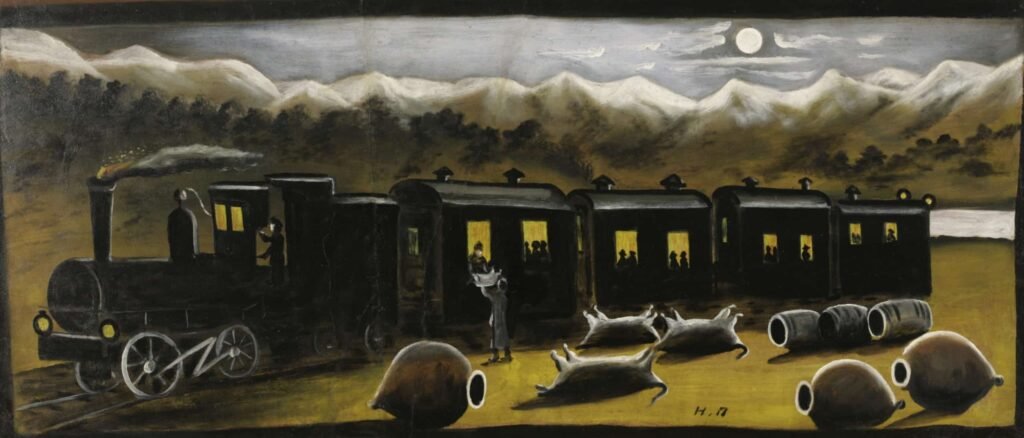
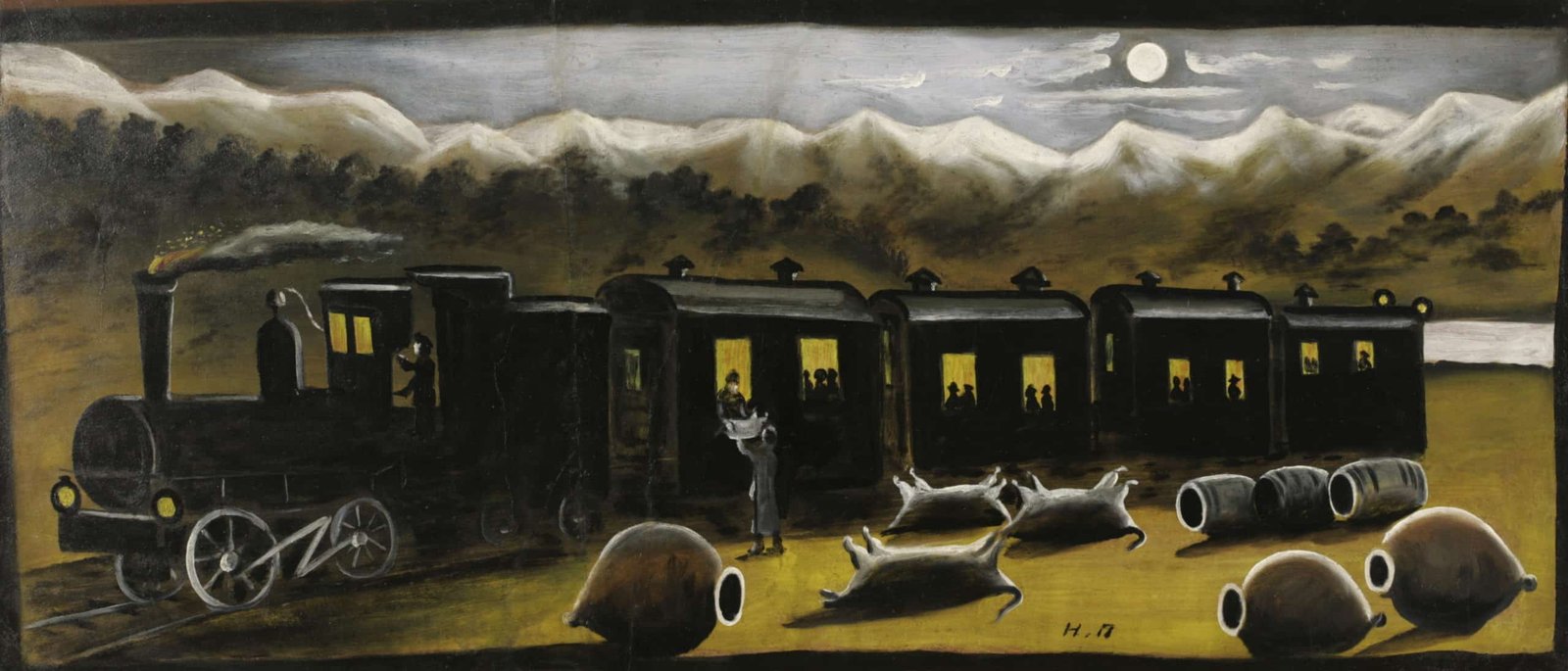
In Niko Pirosmani’s Train in Kakheti (1913), the train runs across a dark field beneath snow-covered mountains. Yellow windows interrupt the black carriages. There are passengers inside, or at least their silhouettes. A lone figure stands near the train. Wineskins, casks, and amphoras lie in front of it, almost as if someone has unloaded the contents of a cellar beside the tracks. The rails are easy to see near the locomotive. Under the carriages they become blurred, and beyond the train they are gone.
I keep returning to that break in the track. The train may have stopped to unload goods; the standing figure suggests as much. Yet the smoke and softened wheels make it seem as though it is still moving. Pirosmani does not settle the question. Day and night are also hard to separate here. So are village life and machinery.[^8]
Train in Kakheti gives us a better opening than the usual labels. Pirosmani is often introduced through words such as “naive,” “primitive,” and “self-taught,” yet the painting does not sit comfortably inside any of them. It is full of modern movement, labor, and trade, even while it refuses the perspective through which European painting often pictured progress.
Pirosmani did work outside the academy. He painted signs and tavern decorations, portraits, feasts, animals, saints, and ordinary scenes from Georgian life. “Naive” can describe the absence of academic training, but it quickly becomes an explanation for everything on the surface: flatness, repetition, frontal figures, uncertain space. Once that happens, a method starts to look like a limitation. “Primitive” goes further. It places the artist somewhere before modernity so that modernism can arrive afterward and claim him.
But Pirosmani’s world was modern Tbilisi. Imperial rule, railway work, commerce, taverns, religious images, rural memory, and new forms of reproduction occupied the city at the same time. The pictures came from this mixture. They were not messages sent from outside history.
His biography has often been made to tell the opposite story. Pirosmani was born Nikoloz Pirosmanashvili in 1862 and died in Tbilisi in 1918. Beyond those dates, parts of his life are uncertain. Fragments gradually became a legend: the poor and solitary painter, working for a meal or a place to sleep, understood only after his death. A major later biography by Giorgi Leonidze drew on memories from wine sellers, street painters, musicians, tradesmen, and railway conductors. Its range is valuable, but it also reminds us how much of the life comes through memory.[^1] The trouble comes when the sadness of the story begins to explain paintings that are controlled, dry, and not especially sentimental.
“Self-taught” needs the same care. Accounts describe an orphan who came to Tbilisi, entered household service, and learned to read and write Georgian and Russian. Exhibition timelines record that he learned drawing, trained as a typesetter, and worked as a brakeman for the Transcaucasian Railway.[^1] A Georgian article from 1924, based on a conversation with the painter G. Zaziashvili, places him in service in Sololaki around the age of twenty-five. Later, the two men shared a small workshop. The same account follows him through railway work and a dairy business. Another note says that the Kalantarov family knew Pirosmani closely and kept a photograph of him as a young man. It does not say that the family gave him painting lessons.[^1]
Kirill Zdanevich offered a more revealing answer in 1923. He named Pirosmani’s “teachers” as Georgian fresco, Persian miniature, popular print, signboard, folk toy animals, tavern life, and the visual culture around him.[^2] The list is romantic in its own way, but it restores an environment to the word “self-taught.” There was no academy. There was still education, work, companionship, and a city crowded with images.
Then there is the oilcloth. It has become part of the romance of Pirosmani, as if he pulled a cheap table covering from a tavern and began to paint. Paustovsky’s 1931 essay was even titled Life on Oilcloth, a measure of how quickly material and biography fused into legend.[^3] Erast Kuznetsov describes something more deliberate: factory-made technical oilcloth, bought for the purpose and perhaps no cheaper than canvas. Pirosmani usually painted it in a thin layer, allowing black to show through and bind the figures to the ground. The material supplied shadow, outline, and color. M. Bilanishvili was already arguing in 1929 that this black was a decision, not an accident of the support.[^6]
In The Feast of Five Noblemen (1906), faces and hands emerge from that black. So do bread, plates, fish, fruit, and wine vessels. The table reaches nearly from one edge of the painting to the other. The men behind it are stiff, but the food presses forward. One can read the whole gathering through the arrangement of the supra, the Georgian feast. The table is not background furniture. It sets the order of the picture.
The same economy appears in Fisherman in a Red Shirt. A man stands in water with a fish in one hand and a bucket in the other. There is almost no scenery to explain where he is. His red shirt carries the image, held against the dark surface by the yellow of his hat and the fixed direction of his eyes. I cannot decide whether the scene takes place in daylight or at night. Pirosmani seems content to leave both possibilities open.
His work in taverns and shops helps account for this directness. A sign had to be readable from the street or across a crowded room. A religious image asked the viewer to stop and look differently. A feast picture had to register people, food, and rank. Pirosmani did not keep these visual tasks apart. He worked on the left bank of the Mtkvari, where art and trade met at the counter. Iliazd’s 1913 article located his works in named taverns and at the Kardanakh wine cellar on Molokan Street.[^5]
Photography also belonged to this environment. Giorgi Papashvili has compared several portraits and theatrical scenes with studio photographs and postcards available at the time.[^4] Pirosmani changed what he borrowed. He flattened their depth, tightened the poses, and made the figures face us with the formality found elsewhere in his work. The process hardly fits the image of an untouched, instinctive painter.
The appearance of directness interested the Zdanevich circle. In 1912, Ilia Zdanevich, later Iliazd, saw Pirosmani’s paintings in Tbilisi with his brother Kirill and Mikhail Le-Dantyu. They looked for the artist. Art.gov.ge still calls Iliazd Pirosmani’s “discoverer.” I hesitate over that word. Pirosmani had already been painting for years. What Iliazd discovered was a way to place those paintings inside an avant-garde story.
The following year, four works were listed in the catalogue of the Moscow exhibition Mishen (Target): a woman holding a beer mug, a portrait of I. M. Zdanevich, a still life, and a deer.[^3][^5] Pirosmani’s pictures hung in odd company. The exhibition included avant-garde painting, children’s drawings, popular prints, African sculpture, sign painting, and amateur work. Many Moscow viewers first encountered him in a display that had already assigned him a place within primitivism.
Iliazd made the theory explicit in his 1913 article “Khudozhnik-samorodok,” usually translated as “A Natural-Born Artist.” The phrase suited artists who wanted to break with academic realism. It also turned a working painter into a figure of pure origin. The tavern commissions, railway labor, religious pictures, and visual habits of Tbilisi became harder to see. In their place appeared the solitary artist who supposedly painted without inheritance or instruction.
Georgian viewers did not respond with one voice. Harry Holland’s 1916 review, “Georgian Primitivist,” accepted the category, emphasized the Giraffe, and called for the paintings to be gathered in a Georgian museum. That same month Mose Toidze defended a Pirosmani exhibition against people who regarded it as comic or insulting to art. He described Pirosmani instead as a raw artistic force for Georgian painting. By 1929 A. Duduchava could compare him to Henri Rousseau and call him both a barbarian and an adult child. Beno Gordeziani, L. Esakia, and M. Bilanishvili paid closer attention to black ground, reduced color, geometry, montage, and what Gordeziani called a “cinematic” way of seeing.[^6] They treated Pirosmani as a painter making choices, not as an innocent who had failed to master painting.
The Zdanevich version nevertheless traveled well. After a large Paris exhibition in 1969, Iliazd returned to Pirosmani in the 1972 artist’s book Pirosmanashvili – 1914. It brought together the earlier article, a new text called “60 Years Later,” and an etched portrait by Picasso.[^7] Work made for Old Tbilisi interiors had reached Moscow futurist circles and then a finely produced Paris book. The book is now in MoMA’s collection. Ilia and Kirill made that passage possible, and they carried the natural-born painter with them.
Recent exhibitions have tried to separate the paintings from this inherited character. Louisiana addressed the myths around Pirosmani and the language of naivete. The Fondation Vincent van Gogh Arles noted that he resisted the naive label. The 2023 Beyeler catalogue placed Georgian art historians beside Kirill Zdanevich rather than allowing his account to stand alone.[^8]
Return to the locomotive with this history in mind. Pirosmani knew railway labor from his years as a brakeman. Before the train became a pictorial sign of progress, it was part of his working life. In the painting it shares the field with mountains, wine vessels, trade, and a solitary person beside the track. Modernity is already in Kakheti. It just does not arrange itself into a metropolitan story.
The feast paintings approach modernity through ritual. Natalia Apchinskaya traces their recurring arrangement to medieval Georgian frescoes: drinkers sit behind a cloth-covered table, the person making the toast stands, and food tilts forward through elements of reverse perspective.[^3] The Beyeler guide also connects Five Princes Carousing with the Last Supper and banquet scenes in Georgian silverwork.[^8] These older forms remain visible in the frontality and peculiar stillness of the scene.
The animals are harder to place. Pirosmani observed markings, bodies, and postures, but he was not making natural-history studies. Apchinskaya calls the works animistic rather than simply animal pictures, noting how strongly Pirosmani endowed them with fear, tenderness, and other states.[^3] His giraffe, bear, deer, and lion look back. Their scale is sometimes strange, and their faces can feel almost human without becoming comic. They have the stubborn presence of portrait sitters.
I would still keep the word “primitivism,” but only as a name for the appetite that formed around the paintings. Modernists wanted art that appeared to come before modernism. Pirosmani seemed to provide it. His pictures, though, came from a city under imperial pressure, alive with commerce and changing technologies. The label helped circulate the work while obscuring much of the place that produced it.
Pirosmani is not the only Georgian artist caught in this arrangement. Georgian art is often made internationally legible through categories produced elsewhere. “Naive” identifies a route outside academic training, but it can also keep an artist outside serious argument. “Primitive” records modernism’s attraction to non-academic form while preserving a hierarchy in which Moscow or Paris grants that form its value.
The black oilcloth offers a more precise starting point. It was not a makeshift replacement for canvas. Pirosmani chose it and learned what its darkness could do.[^3] The same precision belongs to the fading rails in Train in Kakheti. Perspective does not pull the locomotive toward a distant point. Movement comes from smoke, blurred wheels, yellow windows, and the still wine vessels in front.
Near the engine, the rails give the train a route. Under the carriages, they begin to dissolve. Pirosmani does not show where the track resumes, and perhaps that is why the painting stays unsettled. The train is modern, but it never becomes the endpoint or organizing principle of the landscape.