Some songs are made to perform. Others are born for people. Mravalzhamieri (მრავალჟამიერი) belongs to the latter kind. Its name is often translated as “may you live, a many life,” a phrase that carries more than time—it carries a wish: may life be long, may peace remain, may the community endure. In Georgia, where song is not separated from social life, Mravalzhamier is blessing in form of a song.
To Hear it is to understand something central about Georgian culture: joy is not only celebrated, it is shared formally, publicly, and with intention.
The Georgian Table: Where Culture, Wine, and Song Meet
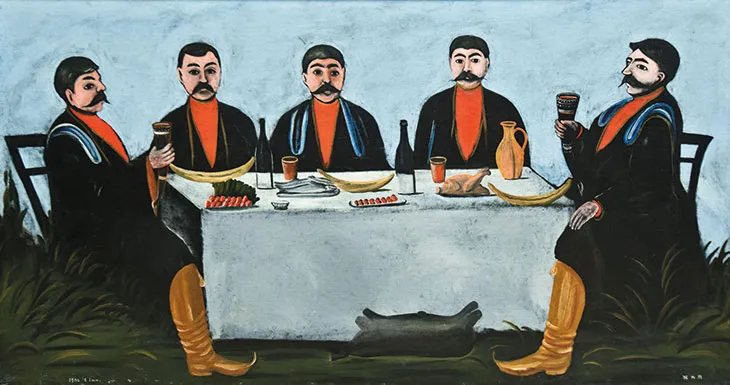
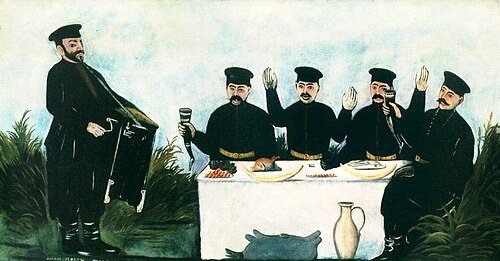
It is no surprise that Georgians—bearers of one of the world’s oldest and richest winemaking traditions—deeply love gathering around the Supra (the traditional Georgian feast). The Supra, with its gastronomy, wine, Tamada (toastmaster), and carefully structured toasts, is not merely a meal. It is an institution—a piece of national culture that continues to captivate Georgian and foreign scholars alike, and sometimes even sparks academic debate.
Decorating a festive gathering with music is common across many cultures. But the genre and style of that music always reflects the character of the culture it belongs to. In the traditional Georgian Supra, the accompanying repertoire was built around polyphonic table songs and festive hymns—and among them, Mravalzhamier held a place of special distinction.
Mravalzhamier is both a table song and a church hymn by name and function. Its meaning—”many years,” “for a very long time,” “forever”—bridges the sacred and the social. At the end of the Divine Liturgy, chanters in Georgian churches often perform a regional Mravalzhamier. At the table, it becomes a communal wish for long life and prosperity.
The line between worship and fellowship, in Georgia, has never been rigid.
A Song That Belongs to Every Corner of Georgia
One of the most striking features of Mravalzhamier is that it is not one song. It is many—shaped by geography, dialect, and local tradition.
Mravalzhamier is especially characteristic of regions rich in grape varieties and winemaking heritage. In Eastern Georgia, you find it in Kakheti, Kartli, and Meskheti. In the West, it appears in Racha, Imereti, Samegrelo, Guria, and Adjara. Some regions have their own dialectal names for it: Brevalo in Guria, Zhamieli or Zhamielurmi in Adjara.
And many carry names that preserve local history:
- Aslanuri Mravalzhamier (Racha) is tied to Aslan Eristavi, a 19th-century figure who reportedly taught the song to a local ensemble.
- Ekvtimuri Mravalzhamier bears the name of Rachvelian singer Ekvtime Gogoladze.
- Benia’s Mravalzhamier honors Imeretian winemaker Benia Mikadze.
- In Kartli and Kakheti, the short Mravalzhamier is sometimes called Erekle’s Mravalzhamier—oral tradition holds that King Erekle II (1720–1798) was especially fond of it.
- Others simply carry the name of their birthplace: Telavuri, Shilduri, Kutaisuri, and more.
Each version is a window into the community that shaped it. The song travels—but it always remembers where it came from.
From Village to City: Mravalzhamier in Urban Folklore
Mravalzhamier proved so essential to Georgian life that it found its way into urban folklore as well.
Georgian traditional music includes an urban folk branch divided into two streams: Eastern (developing from the 17th century under Eastern musical influence in cities of Eastern Georgia) and Western (emerging in the 19th century in Western Georgian cities under the influence of European classical music).
Urban Mravalzhamier belongs to the Western stream. Among the most popular is the C-dur Mravalzhamier, also known as the Kutaisi Mravalzhamier. “C-dur” refers to C major in Latin musical notation—tradition says the song was performed in that key, and the name stuck. According to local lore, it was first performed on stage by the famous Kutaisi personality Pipinia Mikeladze—known for his humor and quick wit—alongside friends Bondo Mikeladze, Sandro Paghava, Kokinia Dgebuadze, and Daniel Janashvili.
A recording from 1909 survives, though the performers and exact location remain unknown. Perhaps the voices on that recording are the very ones the story remembers.
Witnessed by Travelers, Felt Across Centuries
Foreign visitors to Georgia have long been struck by the emotional power of Georgian singing.
In the 1820s, German scientist Eduard Eichwald, after hearing Georgians sing, wrote in his diary:
“The songs rise from the depths of their souls… They strain all their strength and seem to draw their very spirit from the body, so that we may hear voices of sufficient depth.”
Decades later, at the end of the 19th century, French archaeologist and ethnographer Baron de Baye recorded his impressions of a feast in Kutaisi:
“Every toast is followed by a choral song from all those present—a song wishing long life and an ocean of happiness.”
These are not academic observations. They are reactions from people who felt something they could not quite explain—something that Georgian singing does to a room.
Mravalzhamier is not a single song. It is a cultural principle: bless what you love, defend what you value, and do it together.
It has survived in mountain villages and city theaters, in churches and at crowded tables, in 19th-century diaries and early 20th-century recordings. It carries the names of kings, singers, winemakers, and villages—because in Georgia, a song is never anonymous. It belongs to someone, somewhere.
And today, across every corner of Georgia, people still sing it—voices full, glasses raised, wishing each other what the song has always wished:
Many years. Many, many years.